Stop talking about "Watts." In the world of indoor farming, photons are the only currency that matters. Learn the science of PAR and PPFD.
If you walk into a store and buy a light based on its "Equivalent Wattage," you are gambling with your harvest. Wattage is a measurement of electricity consumption, not light output. Your plants don't care how much power your light uses; they care about the number of photons hitting their leaves. To grow like a pro, you need to understand the language of light science.
PAR: Photosynthetically Active Radiation
Humans see light in lumens, which is weighted toward the yellow-green part of the spectrum (the brightest to our eyes). Plants, however, use light in the 400 to 700 nanometer range. This specific range is called PAR. Red and blue photons are the heavy lifters of photosynthesis, which is why older grow lights looked purple ("Blurple"). Modern full-spectrum LEDs include white light for better health but still focus heavily on the PAR range.
PPFD: The Only Metric That Matters
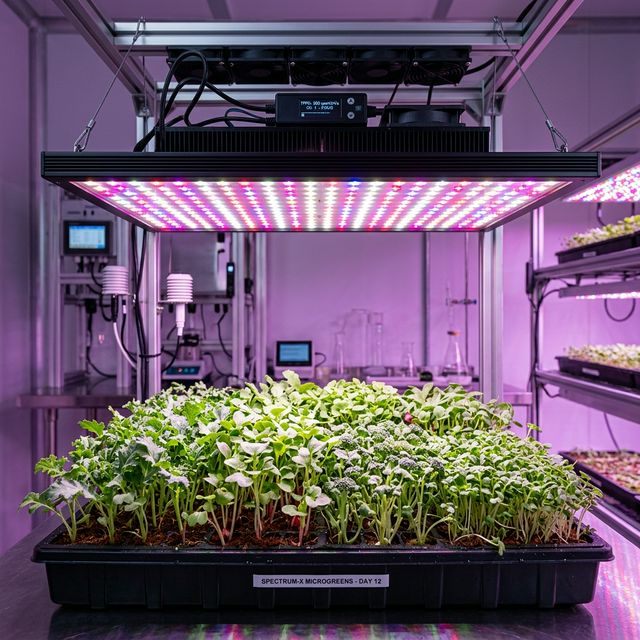
PPFD (Photosynthetic Photon Flux Density) measures the number of PAR photons that actually land on a given square meter of your garden every second. It is measured in micromoles per square meter per second (μmol/m²/s).
Target PPFD Ranges:
- Seedlings: 100–300 μmol/m²/s- Vegetative Stage (Lettuce/Herbs): 300–600 μmol/m²/s
- Flowering/Fruiting (Tomatoes/Peppers): 600–900+ μmol/m²/s
DLI: The "Full Stomach" Metric
DLI (Daily Light Integral) is the total amount of light a plant receives in a 24-hour period. Think of PPFD as the "speed" at which the plant is eating, and DLI as the "total meal."
If you have a weak light but run it for 24 hours, you might achieve the same DLI as a powerful light run for 12 hours. However, most plants need a dark period for respiration, so aim to hit your DLI within 14–18 hours.
The Inverse Square Law: Why Height Matters
Light intensity doesn't drop linearly; it drops exponentially. If you double the distance between your light and your plant, you don't get half the light—you get one-fourth of the light. This is why adjustable hanging kits are mandatory for indoor setups. You want your light as close as possible without causing "heat stress" or "light bleach."
Spectrum: Beyond Red and Blue
- Blue Light (400-500nm): Keeps plants short and bushy. Essential for the vegetative stage to prevent "legginess."
- Red Light (600-700nm): Triggers flowering and fruit production. It tells the plant that summer is ending and it's time to reproduce.
- Far-Red (700nm+): Can speed up the transition to flowering but can also cause plants to stretch.
Choosing an LED in 2026
Look for lights that use high-efficiency chips (like Samsung LM301H or Osram). Check the "PPF Map" provided by the manufacturer. If they don't provide a map showing the intensity at different points under the light, don't buy it. A good light should be "Full Spectrum" (3500K to 4000K) with added 660nm deep red chips.
Conclusion
Understanding light science turns indoor gardening from a guessing game into a predictable system. By targeting specific PPFD levels and managing your DLI, you can achieve professional yields in a closet. Measurements don't lie—photons are the key to the castle.