If your living room looks like a discotheque from the 1980s, it's time for an upgrade. The era of pink and purple grow lights is over.
For decades, indoor gardeners were told that plants only need Red and Blue light to survive. This led to the explosion of cheap, purple-emitting LED panels (affectionately known as "Blurple" lights) on Amazon. While theoretically true that chlorophyll absorbs red and blue light most efficiently, we have since learned that plants use the entire spectrum for healthy growth—and so do human eyes.
The Problem with Purple
Blurple lights were invented to save energy. By only emitting the photons that chlorophyll A and B engage with most (peaks at 450nm and 660nm), manufacturers thought they were being efficient. But they ignored a few critical factors:
- Canopy Penetration: Green light (which blurple lacks) penetrates deeper into the leaf and the canopy than red or blue light. Without green light, lower leaves starve.
- Diagnosis Difficulty: Have you ever tried to spot a yellowing leaf or a spider mite under a purple light? It's impossible. By the time you notice a deficiency, it's often too late.
- Human Health: Living in a customized purple environment is straining on the eyes and psychologically jarring.
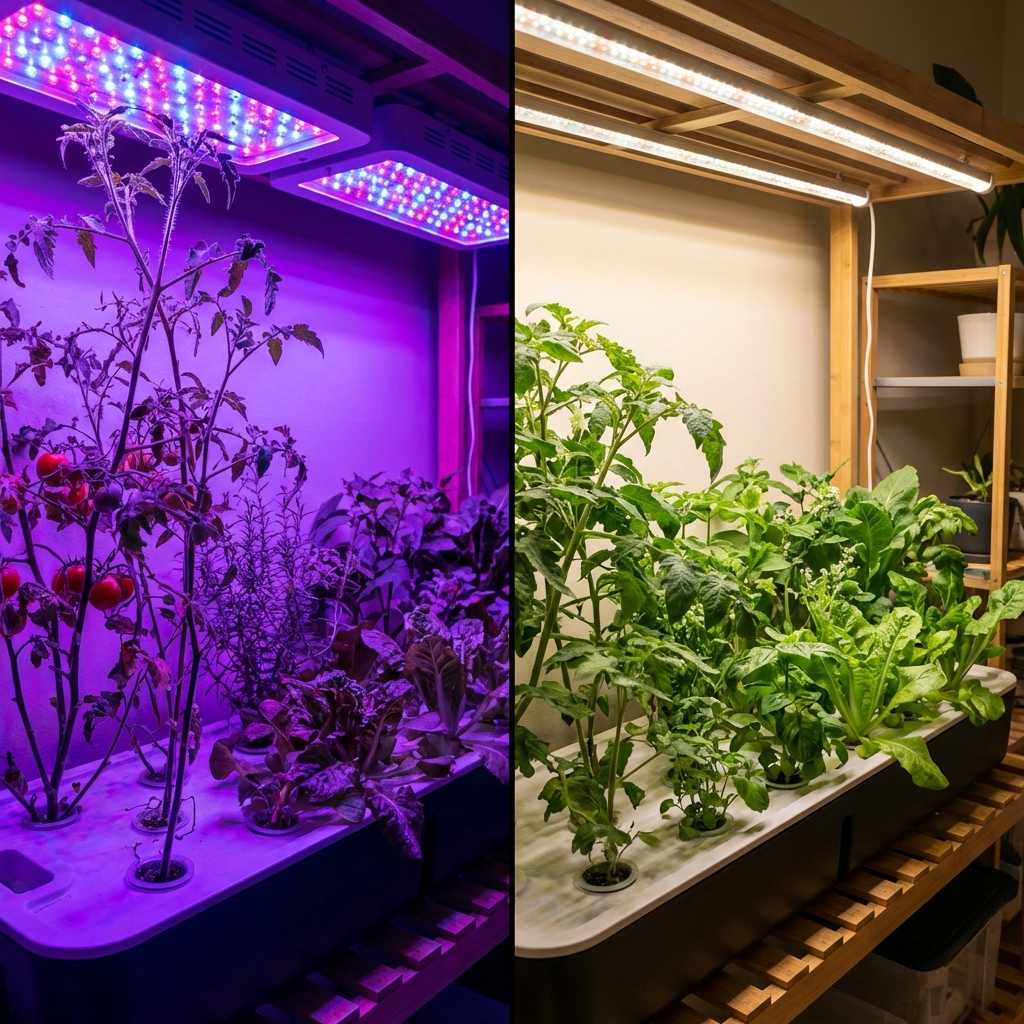
Left: Old tech (Blurple). Right: Modern Full Spectrum LED (Samsung LM301B diodes).
Enter: Full Spectrum White LEDs
Around 2018, everything changed. Samsung introduced high-efficiency white diodes (like the LM301B). These chips emit a full spectrum of light—appearing white to the human eye but containing all the red, blue, green, and far-red peaks plants need.
Why White LEDs Win
The "Full Spectrum" approach mimics the sun. It includes:
- Blue (400-500nm): Keeps plants compact and bushy.
- Green (500-600nm): Drives photosynthesis in deeper plant tissues and allows you to see the true color of your leaves.
- Red (600-700nm): Essential for flowering and fruit production.
- Far Red (700nm+): The "Emerson Effect" suggests that adding far-red boosts photosynthetic efficiency.
Understanding the Specs: PAR, PPFD, and DLI
When buying a light, ignore "Watts" (mostly). A "1000W equivalent" light might only draw 100 watts from the wall. Instead, look for these numbers:
Key Metrics
PPFD (Photosynthetic Photon Flux Density): This measures how much light hits a specific
spot on your canopy per second.
• Seedlings: 100-200 umol
• Vegging: 400-600 umol
• Flowering: 800-1000+ umol
DLI (Daily Light Integral): The total amount of light a plant receives in a day. It's like a rain gauge for photons. Measuring DLI is the most accurate way to grow.
Top Recommendations for 2026
If you are upgrading, look for "Quantum Board" style lights. These are flat aluminum boards covered in hundreds of mid-power diodes.
1. Spider Farmer SF Series: reliable, dimmable, uses Samsung diodes.
2. Mars Hydro TS Used: slightly cheaper, aesthetic reflector design.
3. VIPARSPECTRA XS Series: excellent heat dissipation.
Conclusion
Do your eyes and your plants a favor. Switch to full-spectrum white LEDs. Your plants will grow faster, yield more, and you'll actually be able to enjoy looking at them without wearing sunglasses inside your own home.