Stop buying "cheap" dirt. Most store-bought potting mixes are actually designed to kill your plants over time. Build your own instead.
If you've ever had a plant that looked great for a month and then suddenly turned yellow and stopped growing, the culprit is likely your soil. In a container, the root system is trapped. If the soil is too heavy, the roots suffocate. If it's too light, they dry out. The "perfection" of a container mix lies in its balance of Drainage, Aeration, and Water Retention.
The Problem with "Big Brand" Potting Soil
Most commercial potting soils are over 70% Peat Moss. Peat is great for holding water, but once it dries out completely, it becomes "hydrophobic"—it actually repels water. You'll see water running down the sides of the pot while the center remains bone-dry. Additionally, cheap mixes lack structural integrity, eventually collapsing into a dense, muddy mess that drowns root hairs.
The Three Pillars of a Custom Mix
A professional-grade mix consists of three parts with distinct functions:
- The Base (Structure): Coco Coir or Peat Moss. Holds moisture and provides a matrix for roots.
- The Aerator (Drainage): Perlite or Pumice. Creates "macropores" (air pockets) so roots can breathe.
- The Amendment (Nutrition): Worm Castings or Compost. Provides the biological life and minerals.
The "QuickInfoSpot" Golden Ratio
Mix the following by volume (e.g., using a 1-gallon bucket):
- 2 Parts Coconut Coir (Buffered and rinsed)
- 1 Part Perlite (Coarse grade)
- 1 Part High-quality Worm Castings
- Handful of Azomite or Rock Dust (for trace minerals)
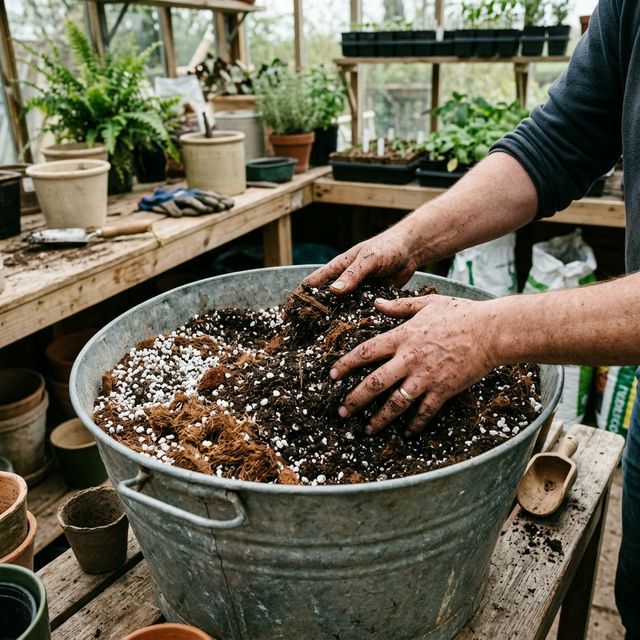
Peat vs. Coco Coir: Which is better?
At QuickInfoSpot, we almost always recommend Coco Coir. Not only is it a renewable byproduct of the coconut industry (unlike peat, which is mined from thousands-of-years-old bogs), but it also has a more neutral pH and re-wets much easier than peat. Note: Always buy "buffered" coco coir to avoid salt toxicity issues.
The Importance of Mycorrhizae
Soil isn't just dirt; it's a living ecosystem. Adding Mycorrhizal Fungi to your custom mix creates a symbiotic relationship with your plant's roots. The fungi act like an extended root system, reaching into tiny crevices to pull in water and phosphorus that the plant couldn't reach on its own. It's the secret weapon of world-record pumpkin growers.
Testing Your Mix
How do you know if you got it right? Use the **Squeeze Test**:
1. Wet a handful of your mix until it's damp but not dripping.
2. Squeeze it hard in your fist.
3. When you open your hand, the ball should hold its shape for a second, but then crumble apart at the slightest touch. If it stays a muddy ball, you need more perlite. If it doesn't hold its shape at all, you need more coir.
Conclusion
Investing $20 extra in high-quality components for your soil will save you $200 in dead plants and fertilizers later. Your plants are only as healthy as the world their roots live in. Give them the ultimate foundation, and they will reward you with explosive growth.